I’ve looked at small business websites publishing four blogs a week while their main service pages barely explained what the business actually did.
And strangely, that’s not rare anymore. At LinkRush, we've reviewed countless small business websites where publishing activity was increasing while the pages responsible for generating enquiries remained underdeveloped. A lot of SEO campaigns today focus heavily on visible activity — publishing frequency, keyword tracking, monthly reports, content calendars — but much less on whether the website itself is building enough trust to compete long term...
A lot of SEO campaigns today focus heavily on visible activity — publishing frequency, keyword tracking, monthly reports, content calendars — but much less on whether the website itself is building enough trust to compete long term, especially now that search is becoming increasingly influenced by AI-driven visibility systems and answer-based search behaviour
That’s usually the bigger issue.
Not every business needs 50 blogs.Not every business needs “advanced SEO systems.”And not every website needs to behave like a national media brand.
Sometimes a business simply needs:
- clearer service pages
- stronger local trust signals
- better internal linking
- cleaner website structure
- and a few genuinely strong authority mentions
That alone can shift rankings more than months of random publishing.
Why Most SEO Services Underperform for SMBs
A lot of SEO services still operate on volume.
More blogs. More reports. More keywords. More deliverables.
But small businesses don’t really invest in SEO because they want “activity.” They invest because they want more enquiries, leads, and visibility for services people are already searching for.
There’s a difference.
One of the most common operational mistakes I still see is agencies targeting informational traffic before the commercial pages are properly built. The website starts attracting visitors who were never especially likely to convert in the first place.
The traffic report looks impressive and sometimes the SEO metrics do too, but artificially inflated metrics rarely translate into long-term business growth
And honestly, some of the highest-performing small business websites I’ve worked on weren’t publishing content every week at all.
That’s probably a slightly unpopular opinion in SEO circles.
But especially in local markets, authority and trust often outperform publishing volume.
A smaller business with:
- strong service positioning
- clear expertise
- trusted mentions
- and a technically clean website
can often outperform larger competitors producing far more content.
What Actually Helps Small Business SEO
For most SMBs, the fundamentals still matter more than people realise.
Service Pages
A surprising number of websites still have weak service pages.
Sometimes the messaging is vague. Sometimes one page tries to target every service imaginable. Sometimes the page focuses more on SEO buzzwords than explaining the actual business.
Good service pages should clearly explain what the business actually does while also making the website easier for both users and search engines to navigate and understand
Sounds obvious, but this is where a lot of rankings are quietly lost.
Google increasingly evaluates whether pages genuinely satisfy user intent, not just whether they contain keywords.
And users make trust decisions very quickly.
If a page feels generic, thin, or unclear, both rankings and conversions usually suffer.
Buyer Intent Keywords Matter More
Not all SEO traffic has business value.
For small businesses especially, commercial intent usually matters far more than raw traffic numbers.
Keywords like:
- SEO service for small business
- affordable SEO services for small business
- local SEO services for small business
- SEO company for small business
often perform better because the intent behind the search is much clearer.
I’d rather rank for fewer high-intent keywords than chase large traffic numbers that rarely convert properly.
That’s one reason many small businesses feel disappointed with SEO campaigns focused entirely on “traffic growth.”
Traffic alone is not the goal. Relevant visibility is.— especially as more searches now end without users ever clicking through traditional search results in an increasingly zero-click search environment .
Technical SEO Still Matters
Not in the “200-page audit document” type of way.
But technical clarity absolutely matters.
I worked on a small local service website last year where rankings improved mostly because we:
- simplified the site structure
- fixed indexing issues
- cleaned up internal linking
- improved crawl paths
- and separated services properly
There was no massive content campaign. No aggressive backlink push or attempt to build more backlinks than a new website actually needs early on
Within a few months, several core service pages started outranking larger competitors locally.
The website simply became easier for Google to understand and crawl.
That’s it.
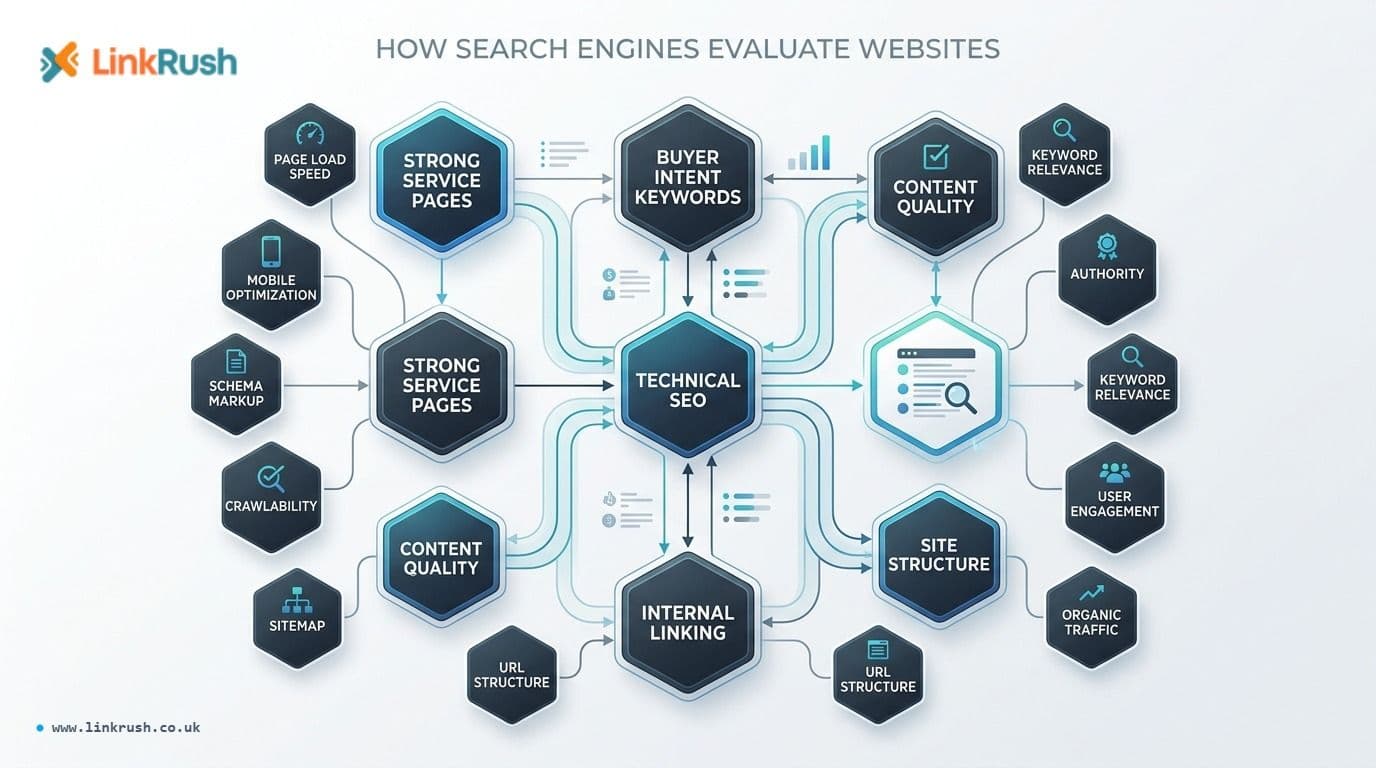
People often underestimate how important clarity is for SEO, particularly when Google is trying to understand topical relationships, crawl structure, and commercial relevance across a website.
Search engines still rely heavily on structure, hierarchy, context, and relevance signals to understand what a business actually offers.
Why Link Building Still Matters in 2026.
There’s a growing narrative online that backlinks don’t matter anymore.
I don’t think that’s true at all.
Low-quality links matter far less now, especially as many smaller websites overestimate how many relevant backlinks they actually need early on. Authority still matters massively.
Google is increasingly evaluating businesses through:
- trust signals
- citations
- topical relevance
- external validation
- brand mentions
- and authority associations
Many of these signals align with Google's broader guidance around experience, expertise, authoritativeness, and trust.
AI-driven search experiences are also leaning more heavily on trusted sources when surfacing businesses.
That’s one reason modern SEO feels very different compared to a few years ago.
Sustainable rankings increasingly come from trusted authority signals, topical relevance, and contextual mentions rather than sheer backlink volume — particularly in modern link building for small businesses.
In many cases, the strongest backlinks are not necessarily the highest DR links, but the ones that genuinely reinforce topical relevance and trust
And interestingly, smaller businesses sometimes have an advantage here.
Large companies often scale content faster. Smaller businesses can build trust faster.
Especially in niche or local markets where reputation, expertise, and consistency matter more than publishing volume.
What I’d Prioritise With a Smaller Budget
If I were building a small business website from scratch today, I’d probably prioritise SEO in this order:
- Strong service pages
- Technical cleanup
- Local trust signals
- Internal linking
- Topical authority
- Relevant backlinks and citations, carefully selected authority mentions
- Content scaling afterward
Most businesses reverse this process, fall into common link building mistakes that quietly damage rankings over time, and then wonder why SEO feels inconsistent.
And to be fair, SEO does feel messy sometimes because there’s so much conflicting advice online now.
But the websites that usually perform best long term are the ones consistently building trust — not just publishing more pages.
Final Thoughts
SEO in 2026 is becoming:
- more authority-driven
- more trust-based
- and far less forgiving toward generic strategies
Small businesses don’t necessarily need massive budgets to compete.
But they do need to focus on businesses that usually win are the ones that build credibility steadily, create genuinely useful pages, improve trust signals over time, strengthen topical relevance naturally, and stop chasing every SEO trend, shortcut, or quick backlink tactic that temporarily becomes popular online.
Good SEO today is less about looking big.
It’s more about becoming genuinely trusted in your space.
And honestly, that’s probably a healthier direction for search overall.
Not Sure Where to Focus Your SEO Efforts?
One of the biggest challenges for small businesses isn't doing more SEO — it's knowing which improvements will actually make a difference.
If your rankings have stalled, traffic isn't converting, or you're unsure whether to prioritise content, technical SEO, local visibility, or link building, taking a step back and assessing the foundations can often reveal the biggest opportunities.
At LinkRush, we help small businesses identify what is holding their websites back and focus on the areas most likely to improve visibility, enquiries, and long-term growth.
If you're unsure where to focus your SEO efforts next, request a free website review and we'll help identify the areas most likely to improve visibility, rankings, and long-term growth.