When Google started rolling out AI Overviews, I noticed something immediately. Clients weren’t asking about rankings anymore — they were asking:
- “Why are impressions up but clicks down?”
- “Why is Google answering before users visit my site?”
- “Do backlinks still matter now?”
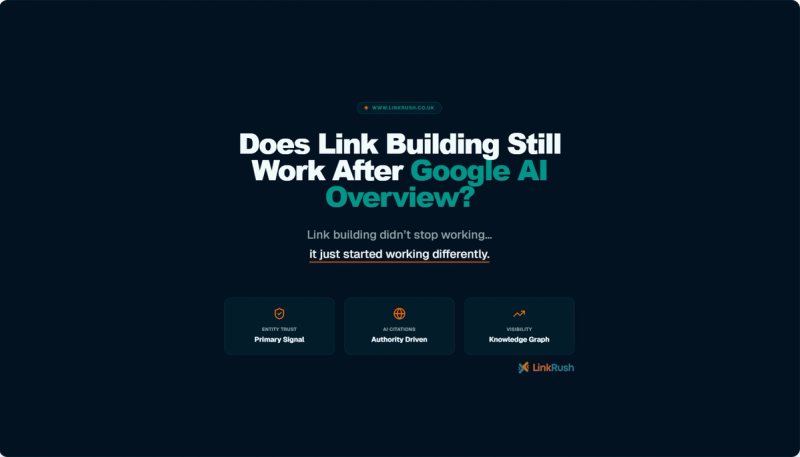
If you're seeing the same shift, you're not imagining it. it’s something we’ve observed across real campaigns we’ve worked on across different niches .Search behavior has changed. But here’s the important part — link building didn’t stop working, it just started working differently.
What Actually Changed With Google AI Overviews
Before AI Overviews, the goal was simple: rank in top 3 → get clicks.
This shift has already been observed in multiple industry studies showing reduced click-through rates when AI summaries appear, as highlighted by platforms like Search Engine Journal. That means:
- fewer clicks for informational queries
- more zero-click searches
- higher competition for authority
The rise of zero-click behavior has been widely documented, especially in research from SparkToro, showing how users increasingly get answers without leaving search results.
What many people miss is that AI Overviews still pull from trusted sources—and those sources typically have strong overall authority signals, including backlinks. This aligns with studies from Ahrefs, which show clear correlations between high-quality backlinks, brand mentions, and top visibility. While backlinks don’t directly influence AI outputs, they play a critical role in building the authority layer that determines which content gets featured — especially when built through editorial link building campaigns that drive real trust and visibility that actually move
In real outreach campaigns I’ve run recently especially comparing manual outreach vs buying backlinks long term results I noticed something interesting. Pages that started getting editorial links from niche-relevant websites began appearing not only in rankings — but also being referenced in AI summaries. This didn’t happen for pages with weak links.
So links didn’t lose value. They became trust signals for AI selection.
Does Link Building Still Work in 2026?
Yes — but mass link building doesn’t. Here’s what I’ve personally seen across campaigns:
- 5 high-authority editorial links outperform 50 low-quality links
- niche relevance matters more than domain metrics
- brand mentions now influence visibility
- contextual links help AI understand topical authority
This pattern is frequently supported by backlink analysis studies published by Backlinko, where fewer high-quality links consistently outperform bulk link strategies.
This shift explains why many older link building strategies stopped producing results. Many of those outdated approaches are covered in detail in common link building mistakes that kill rankings
Where Backlinks Matter More Than Ever
AI Overviews appear mostly for informational searches like:
- "what is link building"
- "how backlinks work"
- "SEO basics"
But for commercial intent keywords, traditional rankings still dominate:
- best link building service
- guest posting service pricing
- buy niche backlinks
- editorial link building agency
- SaaS link building services
These queries still rely heavily on authority — and backlinks remain a core factor, particularly when using niche relevant link building services for long-term growth
Real Example From Outreach Campaign
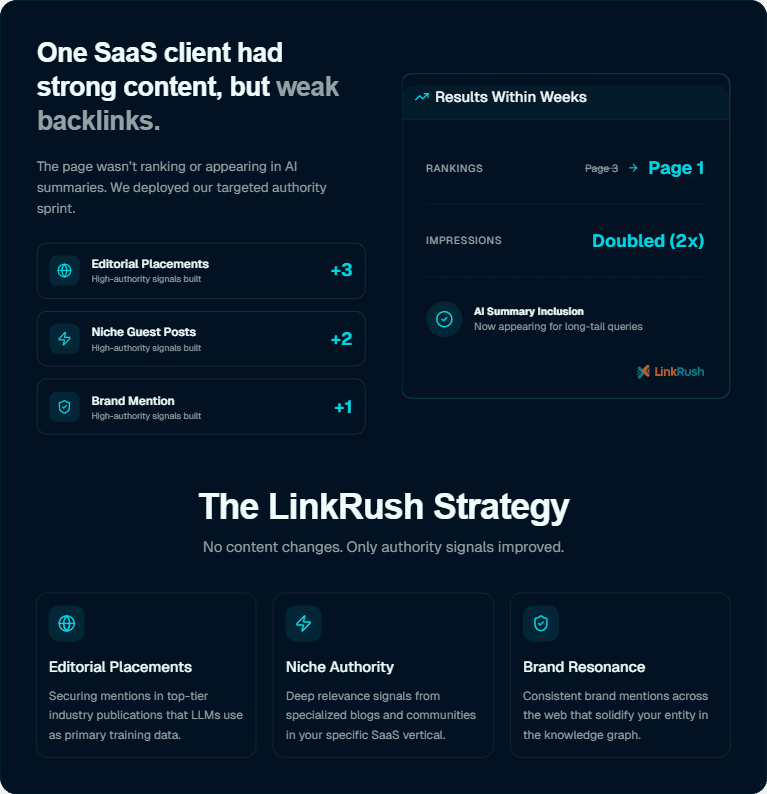
One SaaS client had strong content but weak backlinks. The page wasn’t ranking or appearing in AI summaries.
We built:
- 3 editorial placements
- 2 niche guest posts
- 1 brand mention
Within weeks:
- rankings improved from page 3 → page 1
- impressions doubled
- page started appearing in AI-generated results for long-tail queries
No content changes. Only authority signals improved.
That’s when it became clear: AI systems reward trusted sources, not just optimized content. Even Google’s own documentation and updates discussed by Google Search Central emphasize the importance of trust, authority, and helpful content.
Similar patterns can be seen in this real link building case study from DR12 to DR28 where authority signals alone drove measurable growth.
Link Building Strategies That Still Work
Instead of volume, the focus has shifted toward authority-driven tactics:
- editorial link building for SEO authority
- niche relevant backlinks for topical trust
- digital PR link building campaigns
- SaaS link building outreach
- contextual backlinks for AI search
- brand mention link building
- authority guest posting strategy
- link building for AI overview ranking
- E-E-A-T focused link acquisition
These are currently the most searched long-tail keywords in the link building space. Many of these approaches overlap with guest posting strategies that still work in 2026 especially when combined with editorial placements.
What No Longer Works (And Can Hurt You)
Some strategies that worked years ago now get ignored:
- bulk directory submissions
- PBN link building networks
- irrelevant guest posting
- automated link blasts
- low-quality DR-only links
Google’s AI understands context. If a link doesn’t add topical relevance, it contributes little to authority.
This is also why questions like are Fiverr backlinks safe for SEO keep coming up — because cheap, mass-produced links rarely hold value long term.
The Biggest Shift: Links Now Build Trust, Not Just Rankings
Earlier: Backlinks = ranking boost
Now: Backlinks = credibility + authority + AI visibility
This is why some websites with fewer links outperform competitors — their links are more relevant and editorial.
How Link Building Strategy Should Adapt
Instead of chasing numbers, focus on:
Build fewer but stronger links Prioritize niche relevance Earn brand mentions Target commercial intent pages Strengthen topical clusters Combine links with strong content
This approach aligns with how AI evaluates sources, especially in the context of zero click SEO and how backlinks still drive authority
Are Backlinks Less Important Now?
Actually, they may be more important.
Because:
- AI needs trusted sources
- authority signals determine citations
- strong domains get selected more often
If two pages answer the same question, AI tends to reference the one with higher credibility — and backlinks help define that credibility.
If you're unsure how many links are actually needed, this depends heavily on competition and is explained in how many backlinks a new website actually needs
How much quality backlinks actually cost in 2026
If you’ve ever compared backlink prices and felt confused about how much quality backlinks actually cost in 2026 you’re not alone. Two links can look similar on paper — same DR, same niche — yet one costs $100 and another $1,000+. The difference comes down to quality, placement, and real SEO impact, not just metrics.
From what I’ve seen across campaigns, the market in 2026 roughly looks like this:
- Low-quality links: $100–$250 → easy to get, low impact, often ignored by Google
- Mid-tier backlinks: $300–$700 → decent authority, some ranking improvement
- High-authority editorial links: $800–$2,000+ → strong impact, real traffic, better indexing
- Premium placements (top sites): $2,000–$5,000+ → brand mentions + authority signals
But pricing isn’t really about DR anymore. Many SEO professionals and datasets shared on platforms like Moz highlight how relevance and traffic matter more than raw metrics. What actually drives cost (and results) is:
- Niche relevance (a smaller relevant site often beats a bigger generic one)
- Organic traffic quality (real users vs inflated metrics)
- Editorial control (whether the site is selective or sells links openly)
- Contextual placement (inside meaningful content vs random insertion)
- Indexing reliability (whether the link actually gets picked up by Google)
This is why a DR 40 niche site can outperform — and sometimes cost more than — a DR 70 general blog.
One pattern I’ve consistently seen is that cheap links rarely move rankings. They might look good in reports, but they don’t build real authority. On the other hand, a handful of strong, relevant links can shift rankings within weeks — especially in competitive niches.
Instead of chasing volume, most successful campaigns now focus on fewer, higher-quality links. In many cases, 5 strong editorial links outperform 50 low-quality ones — especially after AI-driven search changes.
If you’re evaluating cost, the better question isn’t “how cheap can I get a backlink?” It’s: “Will this link still help my site 6 months from now?”
Because in 2026, backlinks aren’t just about rankings — they’re about trust, authority, and being worth referencing in search and AI results.
This is why understanding Ahrefs DR vs actual SEO performance is critical before evaluating link value.
Final Thoughts
Yes, link building still works after Google AI Overview.
But the strategy has shifted from:
- quantity → quality
- links → authority
- rankings → trust
- anchor text → topical relevance
The websites that adapt to this change are still growing, while those using outdated tactics see declining performance.
In the AI search era, backlinks don’t just help you rank — they define whether your site is worth trusting, which is why many businesses choose high authority backlinks built through manual outreach
They help search engines — and AI — decide whether your content is worth trusting.
If you're trying to build authority in this new search environment, it often helps to discuss a custom link building plan based on your niche, competition, and growth goals.