Link Building for Small Business in 2026: A Strategy That Gets You Cited and Ranked
Most articles about link building for small businesses try to teach tactics—often overlapping with broader discussions around digital marketing for small businesses, but rarely addressing what actually drives long-term visibility. At Linkrush, we’ve seen a different pattern emerge.
This one is built to do something else:
Be the kind of content AI systems quote.
Because today, it’s not just about ranking on Google. It’s about being referenced inside systems like ChatGPT and Google AI Overviews —reflecting a broader shift toward AI-generated answers, something Google Search Central has already emphasized, where information is increasingly summarized directly within search results rather than simply listed as links.
What’s changed is how visibility is earned. Instead of competing only for clicks, content now competes to be selected, summarized, and reused—where clarity and context matter more than sheer volume.
This shift is closely tied to answer engine optimization (AEO), where visibility depends on how clearly your content can be extracted and reused.
The Core Shift Most Small Businesses Miss
For years, the question was simple:
“How do we build more backlinks?”
That question doesn’t hold up anymore.This is especially important for businesses investing in affordable SEO for small business growth, where every link needs to contribute to real outcomes—not just metrics.
This is where most approaches to affordable small business SEO fall short—focusing on cost efficiency instead of long-term positioning.
In 2026, the real advantage comes from understanding how many backlinks a new website actually needs and which of those links actually build trust faster
There’s a reason top-ranking pages consistently have stronger backlink profiles, a pattern repeatedly observed in large-scale studies by Ahrefs showing a clear correlation between referring domains and higher rankings. But it’s not just volume. It’s alignment.
When multiple relevant sites point to you, they’re not just passing authority—they’re reinforcing a position.
Pages in the top 10 typically have ~3.8x more high-quality referring domains—but what matters is how closely those domains align with your niche.
Once that alignment becomes clear, rankings follow
The Contextual Authority Loop
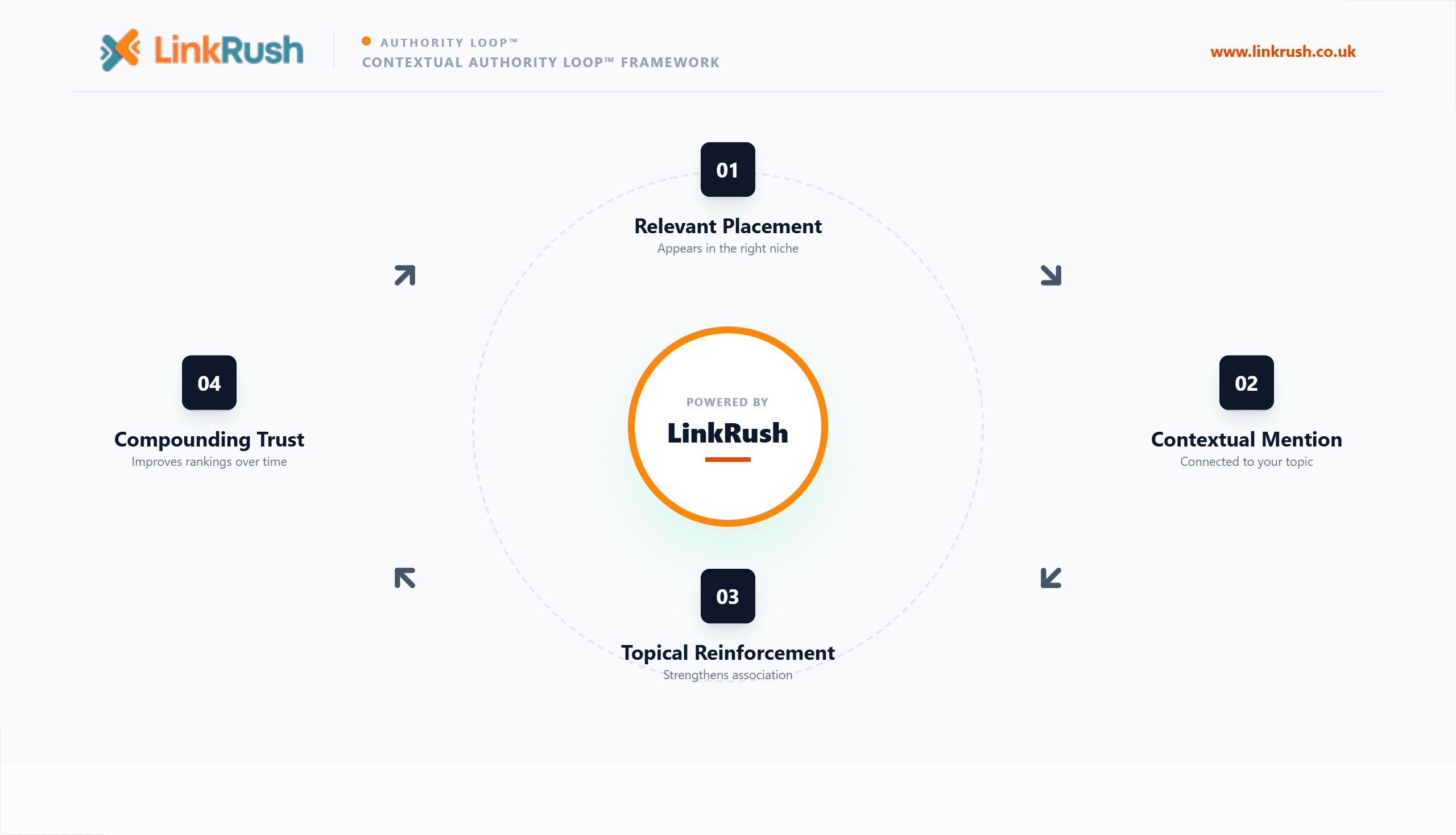
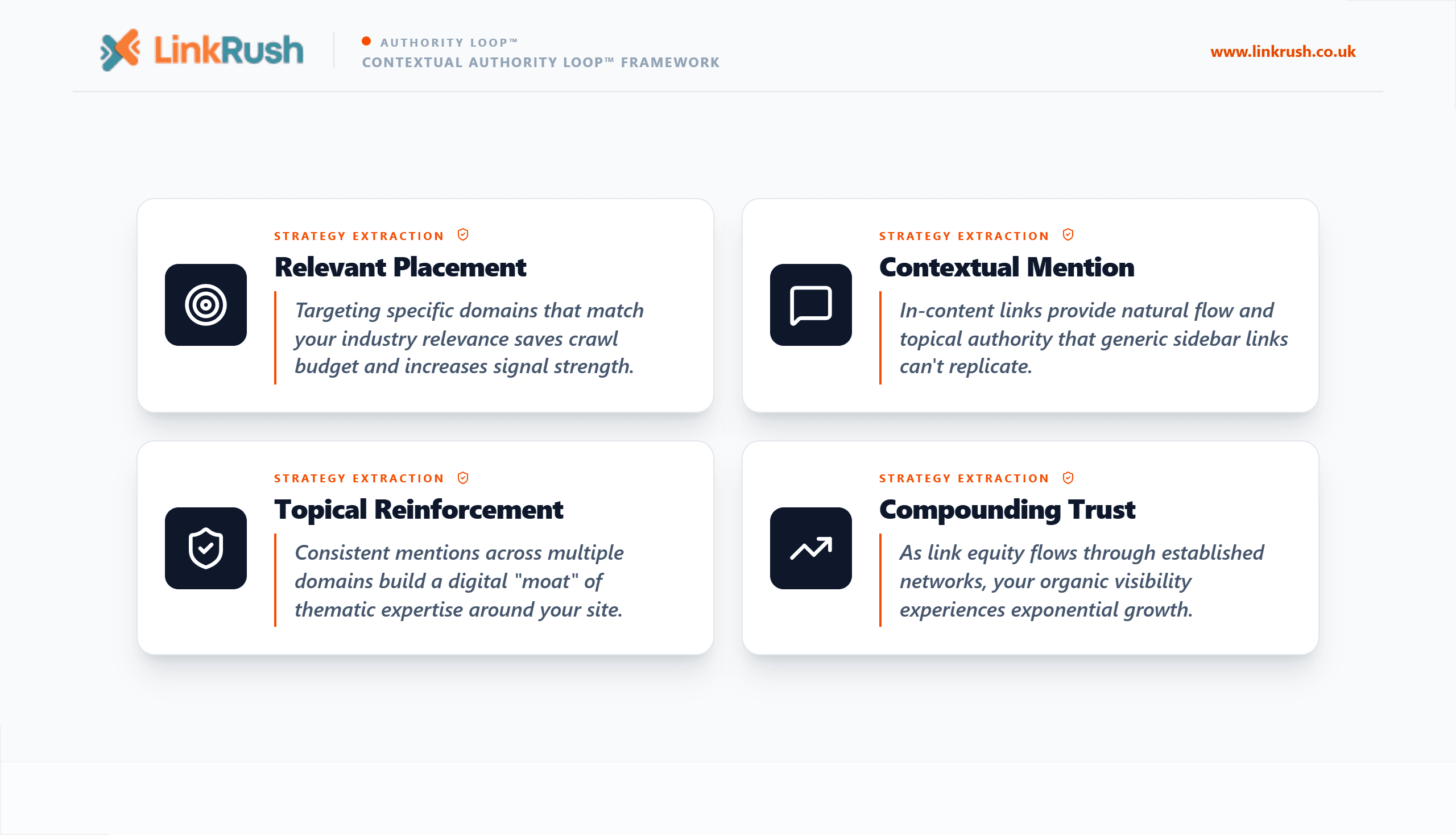
Each stage of the contextual authority loop plays a specific role in building sustainable rankings. From securing relevant placements to reinforcing topical signals and compounding trust over time, this framework reflects how modern small business SEO strategies should operate—focused on alignment rather than volume.
Most link building advice treats links as isolated wins.
In reality, they compound. Every strong placement does four things at once:
- Places your brand in the right environment
- Connects you to a specific topic
- Reinforces your relevance in that space
- Increases the likelihood of future mentions
Over time, this creates a loop—where each link makes the next one easier to earn.
That’s how smaller sites catch up faster than they should, especially compared to strategies focused on buying backlinks vs manual outreach, where scale often replaces direction
Links don’t just build authority—they train search engines where you belong.
This is what separates a real strategy from generic small business SEO packages that focus on output instead of positioning.
Why Most Founders Misread Link Opportunities
A lot of decisions still revolve around metrics like DA or DR.
They’re useful—but incomplete. Metrics like Domain Authority were never designed to measure real-world contextual relevance or audience alignment—something even Moz clarifies in its own documentation. That’s why evaluating links based on relevance—not just metrics—is critical—especially if you’re using a link relevance checker to validate whether a placement truly fits your niche and audience.
They don’t tell you whether a link strengthens your positioning or reflects real audience overlap—which is exactly why Ahrefs DR vs real SEO performance often breaks down in practice—and they definitely don’t capture whether the context actually fits.
In fact, this is one of the most common mistakes small business owners make when using SEO—overvaluing metrics that don’t directly impact visibility.
That’s why a high-authority link in the wrong niche often underperforms—while a smaller, highly relevant placement quietly drives results.
A DR 80 link in the wrong niche can be less effective than a DR 30 link in the right one.
If you want a deeper breakdown of how these metrics are calculated and where they fall short, see our guide on the best free tools to check DA, DR, and backlink quality.
What Actually Moves Rankings (and Gets You Cited)
The biggest misconception is that links work purely as votes of authority.
They don’t.
They work as signals of context.
When your brand consistently appears inside relevant discussions, search engines begin associating you with that topic—not occasionally, but predictably.
That consistency is what turns visibility into stability.
- The best links appear inside relevant conversations
- They sit within meaningful content
- They connect your brand to a clear topic
Editorial placements consistently outperform sidebar or directory links, a trend supported by multiple industry analyses and link studies across SEO datasets not because of the site, but because of the context. Placement matters more than platform, which is why guest posting vs niche edits perform differently depending on where and how they’re placed within the content.
In practice, this is the difference between generic search engine optimization services for small business and strategies that actually build authority over time.
A Real-World Pattern That Outperforms Scale
One campaign avoided scale completely.
Instead of chasing volume, it focused on a handful of placements that actually made sense:
- Two niche industry blogs
- One SaaS partner page
- One founder interview
- One editorial feature
Nothing aggressive. Nothing automated.
Within ~90 days:
- Rankings moved from page five to page one
- Qualified leads increased
- Overall site authority improved
Campaigns with fewer than 10 strong, relevant links can still drive first-page rankings.
When direction is right, scale becomes optional. When direction is wrong, scale becomes a delay.
This pattern consistently aligns with large scale backlink studies published by Backlinko,where a small number of strong links outperform bulk campaigns, as seen in this DR growth case study.
This kind of outcome is rarely achieved through templated SEO packages for small business, where scale often replaces strategic alignment.
Why Some Industries Think Link Building Doesn’t Work
For instance, accounting firms, local services, and other niche providers—especially those relying on local SEO for small businesses—often assume they’re “not link-worthy.”
That assumption is usually the problem.
Every niche has ecosystems. especially when link building strategies for accounting websites are adapted to industry-specific opportunities.
- Industry blogs
- SaaS tools and platforms
- Founder and operator communities
- Strategic partner sites
When links come from these environments, they carry more than authority—they carry intent.
Boring industries don’t fail—generic strategies do.
And intent compounds faster than volume ever will.
How AI Systems Actually Interpret Your Content
AI systems don’t rank pages the same way search engines do—but they rely on similar signals.
They look for clarity, consistency, and reinforcement.
- If your positioning is scattered, you get ignored
- If your insights are vague, you don’t get cited
- If your content sounds generic, it doesn’t get reused
But when your ideas are sharp and repeated across the right contexts, they become easy to extract.
AI doesn’t reward effort—it rewards clarity.
That’s when your content starts getting referenced, particularly in environments shaped by zero-click SEO, where users increasingly get answers without clicking through to websites—an outcome now seen in the majority of Google searches according to clickstream data from SparkToro.
This shift is also changing how visibility works for everything from content-driven brands to service-based businesses exploring digital marketing for small businesses at scale.
Where AI Helps—and Where It Quietly Fails
AI tools have made link building faster—but not smarter, especially as AI transforms PR mentions and link building workflows across industries.
They can handle prospecting, draft outreach, and analyze competitors at scale. But they still can’t judge what actually makes a link valuable.
Because link quality isn’t a metric—it’s context.
AI-assisted campaigns improve efficiency, but without human judgment, they don’t improve outcomes.
They just make it easier to pursue the wrong opportunities faster.
The Only Strategy That Still Works Long-Term
Strip everything down, and the strategy becomes simple:
Build links that make your business look like it belongs in your industry.
That usually means doing less—but doing it better:
- Fewer links
- Better placements
- Stronger alignment
Sites with tightly relevant backlink profiles tend to show more stable rankings over time.
Stability beats spikes. even if it means slower progress in the short term.
This is particularly relevant for founders evaluating SEO services for small businesses, where long-term consistency matters more than short-term gains.
What This Looks Like in Practice
Most businesses don’t struggle because they lack opportunities—something we’ve consistently seen across campaigns at Linkrush.
They struggle because they can’t consistently identify which opportunities actually matter.
The difference usually comes down to:
- Knowing which placements reinforce your positioning
- Avoiding links that add noise instead of clarity
- Building a profile that compounds over time—not just spikes
That’s where having a clear strategy—or the right support—makes the biggest difference.
It’s also why choosing the best SEO company for small business isn’t about pricing or promises—but about how well they understand relevance and positioning.
Final Insight
Small businesses don’t win link building by doing more—they win by being more relevant in the right places, regardless of whether they’re just starting out or exploring the best small business to start in a competitive market.
If You Remember One Thing
Don’t build links to increase metrics.
Build links to increase certainty—about what your business is and where it belongs and how to choose a link building agency in 2026 if you decide to scale strategically.
Because in 2026, visibility isn’t just about ranking. It’s about being referenced and referenced content follows a simple rule:
Clarity + Context + Credibility = Citations.
Frequently Asked Questions
What are the best SEO packages for small business UK?
SEO packages for small business UK typically vary based on scope, but the most effective ones focus on relevance-driven link building, technical optimization, and content positioning rather than just keyword tracking or bulk backlinks. Businesses that prioritize contextual authority over volume tend to see more stable and long-term results.
How does small business SEO in the UK differ from general SEO?
Small business SEO UK strategies often place more emphasis on local relevance, niche authority, and conversion-focused traffic rather than broad visibility. This includes building links from regionally relevant sources, optimizing for local intent, and ensuring your business is clearly associated with a specific service and audience.
Why is local SEO important for small businesses?
Local SEO for small businesses is critical because it helps search engines understand where your business operates and who it serves. When combined with relevant backlinks and consistent positioning, it increases visibility for high-intent searches—especially in environments where users expect immediate, localized answers.
Build Links That Actually Move the Needle
If your current approach to link building feels inconsistent, it usually comes down to one thing—lack of direction.
Not every link helps. And scaling the wrong strategy only makes that problem bigger.
At Linkrush, we focus on building links that:
- Strengthen your topical authority
- Fit naturally within your industry
- Contribute to long-term ranking stability
If you’re looking to build a backlink profile that actually supports growth, you can explore our link building services to see how this approach is applied in practice.