A Founder Case Study on Fiverr Backlinks SEO
Most Fiverr backlinks are not safe for long-term SEO. They may cause short-term ranking fluctuations, but they rarely build durable authority or trust signals that compound over time.
A more useful question than “is buying backlinks safe” is whether the links actually strengthen your authority profile. Safety isn’t just about avoiding penalties. It’s about whether the signal compounds or fades.
When rankings stall, shortcuts start looking rational.
We had a blog page sitting between positions 26 and 31 for over a month. The content was solid, internal linking was structured, and there were already a few legitimate backlinks pointing to it. But growth had flattened. No upward trend. No new impressions curve.
That’s when the question came up internally: Should we test Fiverr backlinks?
We weren’t looking for a shortcut. We just didn’t want to dismiss something without testing it ourselves.
So we ran a controlled experiment.
Why We Tested Fiverr Backlinks.
The appeal is obvious.
On Fiverr, backlink services promise things like high-DA placements, contextual guest posts, quick indexing, and usually some version of “scale without outreach.
For under $150, you can buy what looks like the same outcome that traditional outreach might charge five times more for.
On a spreadsheet, that’s tempting. Lower cost per link. Faster turnaround. More volume.
That’s usually where the broader question shows up: are cheap SEO services worth it? On paper, they solve a cost problem. In practice, this is often why cheap SEO fails — it optimizes for volume instead of signal strength.
But links aren’t inventory units. They’re trust signals.
A real editorial placement usually involves friction — outreach, review, edits, sometimes rejection. That friction is what creates signal strength. Someone chose to link.
Cheap packages remove the friction. And when there’s no friction, there’s usually no real endorsement behind it.
It’s easy to frame it as $120 versus $600. But that’s the wrong comparison. The real difference is controlled placement versus genuine endorsement — and those behave very differently over time.
Test Setup and Methodology
We selected:
- A mid-competition keyword (approx. 1.4K monthly searches)
- A page consistently ranking position 29
- No recent backlink additions in the prior 60 days
- Stable ranking history (no volatility spikes)
We purchased two placements:
- One “high DA contextual guest post”
- One smaller niche-relevant link package
No mass spam blasts. We wanted this to reflect what a rational founder might realistically try — not an exaggerated stress test.
From purchase to publication, both links went live in under six days. That speed alone told us we weren’t dealing with true editorial negotiation.
We tracked:
- Daily ranking movement
- Search Console impressions
- Anchor text patterns
- Referring domain trust shifts
- Crawl frequency
Ranking Results After 30 Days
During the first week, the page moved from position 29 to 24.
That kind of jump creates optimism. It feels like momentum. You start thinking the links are doing their job.
By week two, the page dropped to 33.
We hadn’t changed anything else — no content edits, no internal link adjustments — so the backlinks were the only new variable. That drop mattered.
Week three, it recovered to 28. Week four, it settled at 30.
After 30 days, we were basically back where we started. No sustained ranking gain. No meaningful traffic increase. Impressions stayed within normal fluctuation.
It didn’t feel like authority building. It felt more like the algorithm poking the page, checking if the new signals justified a shift.
When new links appear, search systems often reassess a page. You can see how Google evaluates link signals in their official documentation on link spam and ranking systems.There can be a temporary lift while the algorithm evaluates the new signals. If those signals don’t strengthen overall trust, the ranking normalizes.
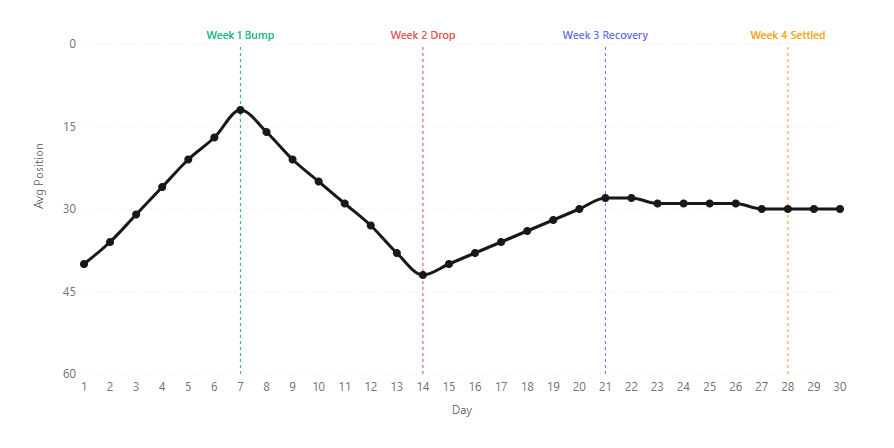
That’s the difference between a bump and real authority. One is a test. The other compounds.
One thing we noticed in Search Console: impressions rose slightly during the first 10 days, but click-through rate didn’t move. That usually tells you visibility is being tested, not rewarded.
Backlink Quality Analysis
The domains were technically real.
But:
- Content quality was thin
- Topic relevance was broad and inconsistent
- Outbound linking patterns were commercial-heavy
- Formatting structure across different domains looked suspiciously similar
There were no clear signs of a real audience. No comment activity. No social signals. No editorial voice consistency.
This is also why backlink packages don’t work long term. When links are produced in batches without real editorial discretion, they behave like inventory — not endorsements.
This is usually where the real question surfaces: are backlink packages worth it if they’re built for scale rather than scrutiny? In most cases, scalability replaces editorial discretion — and that tradeoff shows up months later.
Modern link evaluation systems at Google don’t rely on surface authority metrics alone. They assess linking context, historical domain behavior, outbound patterns, and how those signals fit into a broader trust graph.
This isn’t just anecdotal. Large-scale .backlink correlation research published by Ahrefs and ranking factor studies from Semrush consistently show that link quality and referring domain authority correlate more strongly with sustained rankings than sheer link volume.
On paper, the metrics looked acceptable. Once we examined context and linking behavior, the weakness became obvious.
We also manually checked three other outbound links on those domains. Two pointed to unrelated industries using commercial anchors. That pattern made the placements feel less editorial and more transactional.
That’s why they didn’t compound.
Dilution vs Penalty: What Actually Happened
We did not receive a manual action. There was no traffic crash. But we observed something subtle.
Later, when we acquired two genuine editorial placements through direct outreach, the lift was slower than expected.
It appeared that low-signal domains in the profile slightly reduced the overall authority impact of stronger links.
There was no visible damage. Just slower momentum than expected. And over months, that kind of drag adds up.
Google’s spam updates in recent years have increasingly focused on link patterns rather than just volume.
Are Fiverr Backlinks Ever Safe?
Some sellers likely provide legitimate outreach placements.
There are a few patterns we’ve learned to watch for — instant delivery guarantees, full anchor control promises, unusually large volume at low cost, and repeated publishing structures across domains.
True editorial links are unpredictable. They involve negotiation. They involve rejection. They rarely guarantee anchor text.
That unpredictability is exactly why the benefits of editorial backlinks aren’t instant ranking spikes. They’re contextual authority, relevance, and trust signals that age well.
If the process feels mechanical, it usually is — and mechanical links don’t behave like endorsements.
We break down this difference more clearly in our comparison of guest posts vs niche edits, especially around how editorial control changes link value.
Final Verdict
Can Fiverr backlinks create short-term ranking fluctuation? Yes.Do they reliably build durable authority? Rarely.
Would we use them again for a brand we plan to grow for years?
No.
Not because they’re inherently toxic.But because they don’t meaningfully strengthen trust signals.
And in competitive SEO environments, trust is the asset that compounds.
This is the same distinction you see in SEO packages vs custom SEO strategies. One is standardized deliverables. The other is diagnosis-driven execution. Links behave the same way.
Fiverr backlinks can create short-term movement. But long-term SEO is built on signals that resemble real endorsement, not inventory.
The real inflection point isn’t where you buy links. It’s whether you had an SEO strategy before buying backlinks in the first place.
Do You Need SEO Consultation Before Buying Links?
If this experiment revealed anything, it’s that buying links is rarely the first question you should be asking.
A better question than “where can I buy links?” is “do I need SEO consultation first?”
In many cases, ranking stagnation isn’t a backlink issue at all. It’s structural, technical, or content-depth related.
Knowing how to choose an SEO consultant matters more than choosing a link vendor. A real consultant diagnoses the root cause before recommending authority acquisition.
The Real Question You Should Ask
Not: “Will this move me five positions?”
But: “Will this improve my domain’s credibility six months from now?”
Those are two very different objectives — and they lead to very different strategies.
If You’re Considering Fiverr Backlinks
If you’re debating whether to test Fiverr links yourself, pause for a moment.
Look beyond the short-term lift.
Are you trying to create movement — or build durable authority?
If you want a second opinion on your current backlink profile or growth strategy, we review link structures and trust signals across campaigns at Linkrush.
Sometimes the issue isn’t volume.
It’s signal quality.