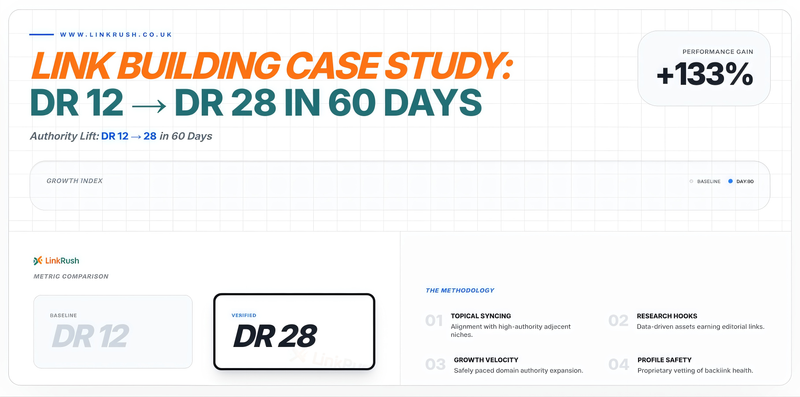
Link Building Case Study: DR 12 → DR 28 in 60 Days
So… DR 12. Not great. Not disastrous. Just… stuck.
We had a small website in the productivity tools space a client project at Linkrush, aimed at small teams. Pages were indexed. Content existed. Some of it was actually decent. But traffic? Almost nothing. Keywords were sitting on page 4 or 5, untouched for months.
Every time we opened Ahrefs or Google Search Console, it felt the same. No movement. No momentum. Just silence.
And the thought that kept coming back was uncomfortable:
Why would anyone link to us?
That question sat behind every outreach email we wrote. It made us second-guess the content, the positioning, even the site itself.
This isn’t a polished success story. It’s a week-by-week breakdown of what actually happened — mistakes, small wins, doubt, and slow progress — while taking a site from DR 12 to DR 28 in 60 days.
Here’s the full 60-day timeline before we break it down week by week.
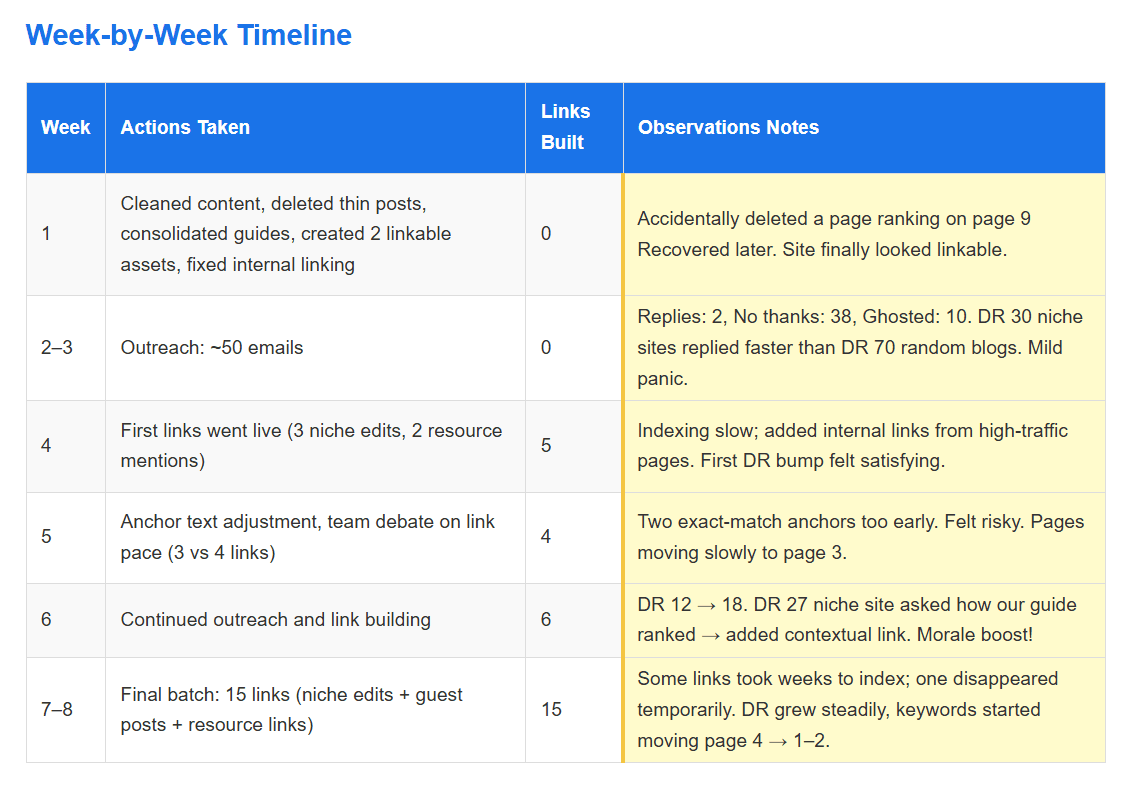
Week 1: Foundation (Painful, But Necessary)
Before we touched a single link, we had to face something uncomfortable.
The site didn’t really deserve links yet.
Not fully.
Some posts were decent. A few were doing okay. But too much of the blog existed just to exist.
So we cleaned the house.
Thin posts went first. The kind written to “fill the blog.” A few had traffic history, which made deleting them harder than it should’ve been. Still, keeping them felt worse. They were dead weight.
Then we merged similar guides. Three weak posts became one stronger page. Fewer URLs. More depth. Less confusion — for users and for Google.
Only after that did we build anything new.
Two linkable assets:
- A data-backed guide with screenshots, small datasets, and opinions we actually believed
- A comparison post that didn’t play it safe — real pros, real cons, no feature-padding
Internal linking was a mess too. We fixed 12 broken anchors and rebuilt topical clusters so supporting posts finally pointed to something meaningful.
What not to do (learned the hard way): I deleted a post ranking on page 9. Didn’t notice for two days. Recovered it later from backup, but yeah — that one stung.
Lesson learned: backups first. Cleanup later.
Week 2–3: First Outreach (Cringe & Frustrating)
This is the phase no one glamorizes.
Confidence drops fast here.
We sent around 50 personalized outreach emails. Not templates. Real effort. Still…
- Replies: 2
- “No thanks”: 38
- Ghosted: 10
At send-time, the emails felt fine. At midnight, rereading them? Less fine.
That’s when something clicked.
DR 30–35 relevant niche sites replied. DR 70 generic blogs didn’t even open.
On paper, big DR looks impressive. In reality, relevance decides who cares. We also double-checked how we were evaluating sites using various tools to check DA, DR, and backlink quality before deciding who to reach out to.
There was mild panic. I reread every email. Tweaked subject lines. Wondered if the content just wasn’t good enough.
Maybe it wasn’t perfect. We kept going anyway.
Week 4: First Links Land
Finally — something moved.
Five links went live:
- Three niche edits, placed naturally inside existing content
- Two resource mentions
Indexing was slow. Painfully slow.
So we helped Google a bit. Added internal links from already-indexed, higher-traffic pages. Nothing fancy. Just logical paths.
Link Placement Examples
Niche Edit: In “Top 10 Productivity Tools for Small Teams” — anchor text: task management tools” (contextual paragraph)
Guest Post: Small SaaS blog, DR 33 — anchor text: “team collaboration tips”, placed in 2nd paragraph Resource
Link: Added to “Best Productivity Tools Resources” — anchor text: naked URL
Reality check: This part is boring. Waiting. Refreshing Search Console. Refreshing Ahrefs. Waiting again.
Still, seeing the first DR movement made it feel real.
Week 5: Mid-Campaign Panic
This week wasn’t clean.
Two exact-match anchors went live earlier than planned. Didn’t love that. Felt risky.
Then came the debate. Play it safe with three links? Or Push slightly and go with four?
We overthought it. Grabbed coffee. Made the call.
Nothing exploded. But something shifted. DR crept up. A few pages moved from page 4 to page 3.
Small wins. Enough to keep momentum alive.
Week 6: Real Movement
This is where the doubt finally started to fade.
Not all at once. Just enough to notice.
By this point, DR had moved from 12 to 18. Nothing dramatic, but it was real. More importantly, pages were starting to shift.
Some moved from page 4 to page 3. A couple even brushed page 2 and then slipped back again. Still, it was a movement.
Outreach replies picked up slightly too. Targeting got sharper. Fewer emails. Better fits.
One moment stuck with me.
A DR 27 niche site emailed asking how our guide was performing. We sent screenshots. No pitch. No follow-up. They added a contextual link without negotiation.
It wasn’t a big win on paper. But it felt like confirmation.
Small moment. Big morale boost.
Week 7–8: Closing Phase
By this point, there was no strategy debate left. It was just execution.
We added around 15 more links over the final stretch. Mostly niche edits. A few guest posts. Some resource links that took longer than expected.
Indexing didn’t suddenly get easier. One link disappeared for a full week. That was annoying. We assumed it was gone. Then it came back. No explanation.
By day 60, things finally settled enough to look at the numbers without refreshing every hour.
- DR: 12 → 28
- Referring domains: nearly doubled
- Keywords: several low-volume pages moved from page 4 into page 1–2
- Traffic: not explosive, but steady — and real
Nothing spiked. Nothing felt artificial. And that was kind of the point.
Notes
- Fewer good links beat many average ones
- Relevance matters more than DR
- Link velocity matters — slow feels boring, but it works
- Mistakes are normal (deleted posts, wrong anchors, bad emails)
- Friction isn’t failure — it’s feedback
Final Thoughts
Moving DR 12 → 28 in 60 days isn’t magic. It’s patience. Relevance-first link building. Real content. Small frustrations. Messy, human execution.
We didn’t start with outreach lists or tools. We started by asking harder questions:
Does this content actually deserve links?
Would we reference it if it wasn’t ours?
Are we optimizing for relevance — or just DR?
The execution was simple (not easy):
- Cleaned and consolidated weak content first
- Built pages worth linking to, not just ranking
- Prioritized relevant niche sites over inflated metrics
- Kept link velocity slow and natural
- Fixed internal paths so links passed real value
No bulk blasts. No guaranteed metrics. No hype.
If you want to see how this approach applies to your site, we can take a look at your Content quality, internal linking, realistic link opportunities
No pitch. No obligation. → Get a free link audit