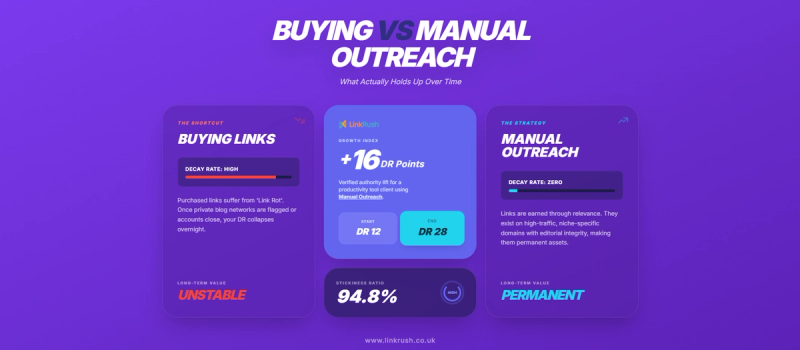
Buying backlinks and manual outreach both work — at first. The real difference shows up months later.
Most don’t fail because they chose the wrong tactic. They fail because they stick with a tactic long after it’s stopped helping. Buying backlinks and manual outreach both have their place—but they behave very differently once Google has more data.
It’s why we structure campaigns around durability rather than short-term lift.
Buying Backlinks: Short-Term Gains, Long-Term Risk
Buying backlinks is efficient. You can move a page quickly. You can test demand. You can see rankings respond.
That’s not the issue.
The issue is durability.
Paid links often appear on websites where links are the primary product. Even when those sites look legitimate, the intent behind the link is typically commercial rather than editorial. Google Search Central has repeatedly stated that links intended to manipulate rankings fall outside its guidelines.
Over time, Google appears to reassess these signals—not always through penalties, but through gradual discounting as intent and context become clearer.
The result usually isn’t a penalty.It’s stagnation.
This pattern is consistent with how non-editorial links are quietly devalued over time, rather than actively penalised, as outlined in Google Search Central guidance.
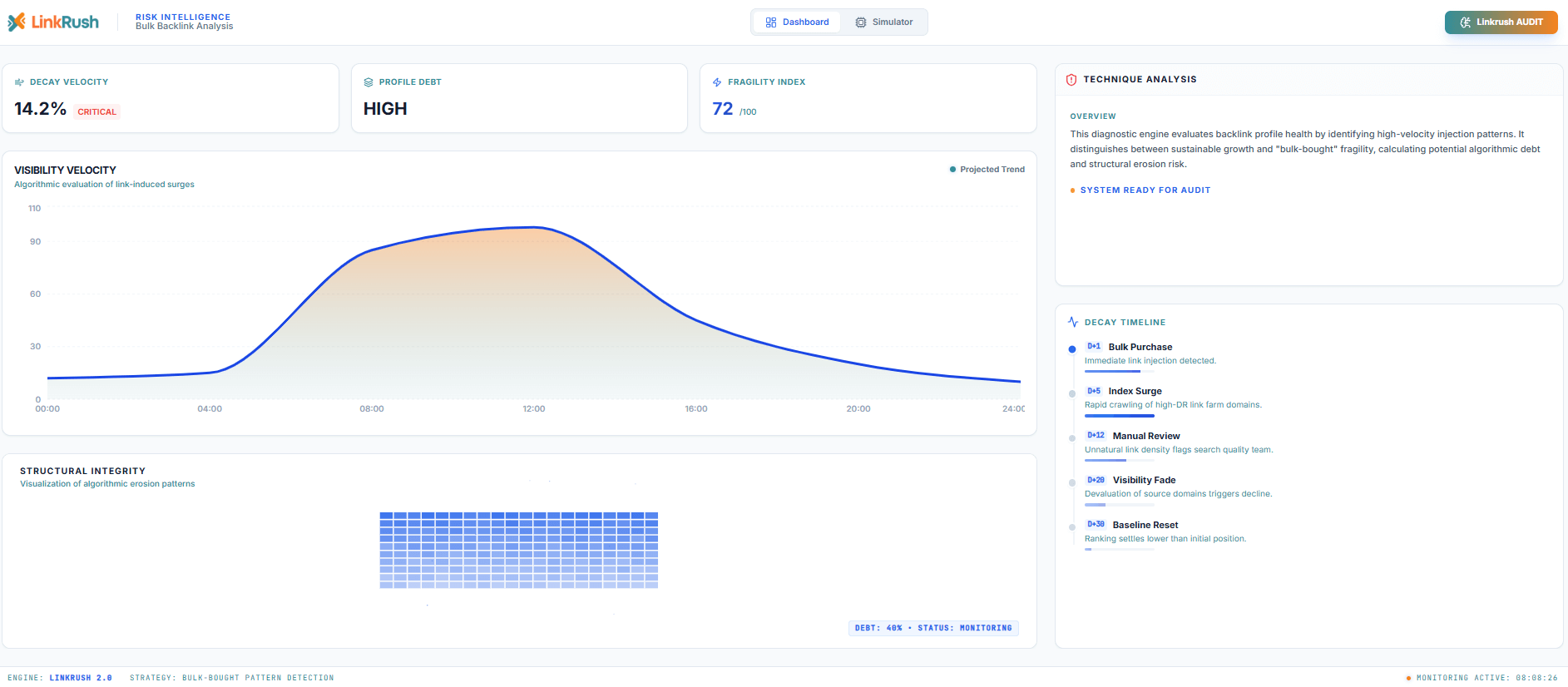
You’ll notice it when:
- New pages struggle to gain traction
- Rankings move, then settle back
- Each gain requires more links than the last
Buying backlinks didn’t break the site. They just stopped pushing it forward.
Manual Outreach: Slower, But Structurally Stronger
Manual outreach is harder to justify early. It’s slower. It’s inconsistent. It doesn’t create dramatic charts.
But it does something paid links rarely do—it reduces friction across the entire site.
When links come from sites that choose to reference you, the impact isn’t limited to a single URL. Industry analysis from Ahrefs’ research on high-quality backlinks shows that pages can rank without direct backlinks when supported by strong domain-level authority, and that links placed editorially within relevant content correlate more consistently with stable rankings than isolated or templated placements. The effect isn’t isolated to one URL.
We’ve seen:
- Pages ranking without direct links
- New content indexing faster
- Rankings holding through updates
That doesn’t come from volume. It comes from editorial confidence.
Understanding link quality matters more than link volume. If you’re unsure how to evaluate domain strength, anchor context, or placement signals, we’ve broken down the best free tools to check DA, DR, and backlink quality in a separate guide.
Why an Outreach-First Strategy Builds Durable Rankings
Don’t avoid paid links entirely. We avoid leaning on them.
Our campaigns usually focus on:
- Sites already relevant to the topic
- Contextual mentions instead of forced anchors
- Brand signals over keyword manipulation
The goal isn’t to “build links.” It’s to make the site easier to trust.
If you’re curious how your competitors are earning links—not just where—they can be mapped fairly quickly. → You can request a quiet competitor link gap breakdown from Linkrush.
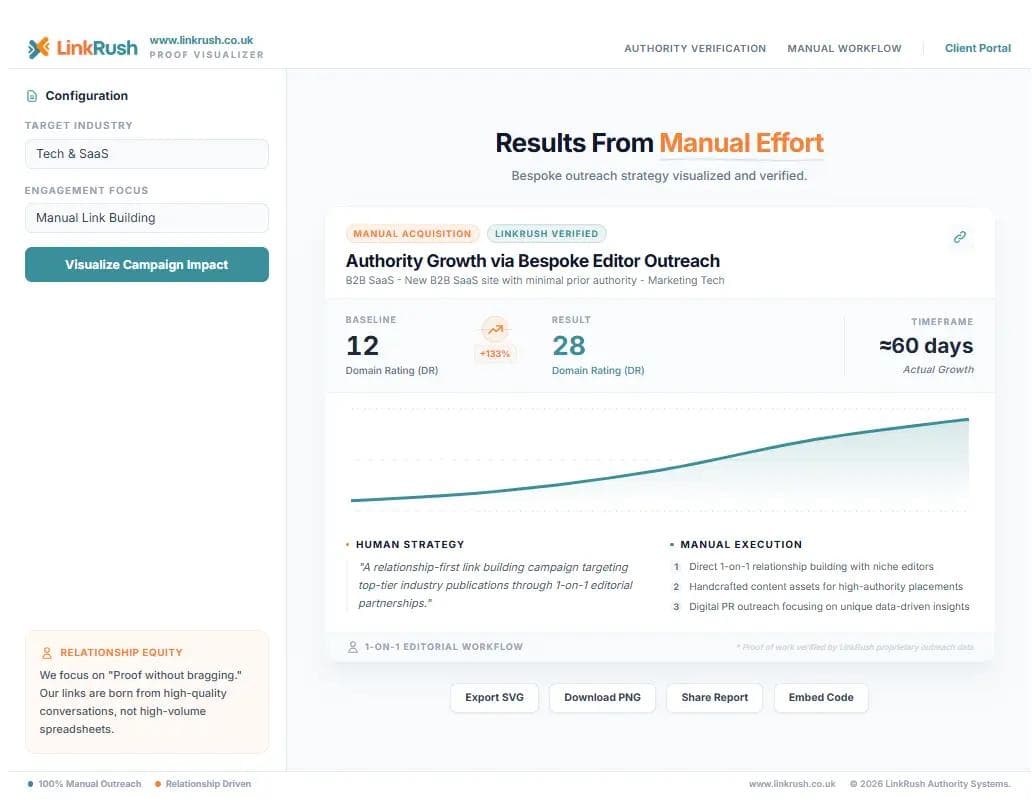
Case Study: DR 12 to DR 28 Using Editorial Outreach
This was a small website. No brand recognition. No press. No shortcuts.
Starting point:
- DR 12
- Keywords buried beyond page 3
- Flat organic traffic
Approach:
- Three genuinely useful assets
- Outreach to sites already citing similar tools
- Brand mentions accepted where they made sense
Outcome (≈60 days):
- DR increased to 28
- Multiple keywords entered page 1
- Traffic grew steadily, not in spikes
- Rankings held without ongoing link pressure
Here’s what the outcome looked like after ~60 days of manual editor outreach.
This campaign is documented in full—including outreach approach and editorial placements—in a detailed link building case study on the Linkrush blog.
The Real Cost: Buying Links vs Earning Them
Buying backlinks feels cheaper—until momentum slows.
Outreach feels expensive—until rankings stop slipping.
One requires maintenance. The other creates stability.
Most sites that struggle long-term aren’t penalised. They’re just unsupported.
Final Takeaway: Movement vs Stability
Buying backlinks can move a page. Manual outreach strengthens a domain.
The difference isn’t visible in week one. It becomes obvious in month six.
If you want to see how competitors are earning editorial links in your niche, you can request a quiet breakdown at Linkrush.