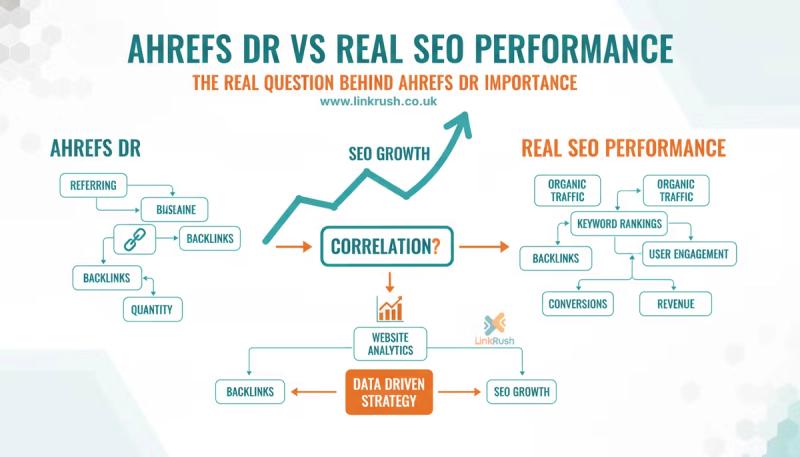
The Real Question Behind Ahrefs DR Importance
At Linkrush, we often see a point where almost every SEO conversation quietly turns into a Domain Rating conversation.
Traffic dips ? “Check DR.” Competitor outranks you? “What’s their DR?” Client unhappy? “We need to increase DR.”
And that’s where the confusion around ahrefs dr importance begins.
Before asking how to increase it, most people don’t even pause to ask — what is domain rating actually measuring?
Domain Rating is a metric built by Ahrefs. It’s a logarithmic score from 0–100 that reflects the relative strength of a site’s backlink profile based on referring domains and link equity flow.
It does not measure traffic.It does not measure rankings.It does not measure revenue.
Yet it becomes the north star. That’s the first mistake.And honestly, that shift usually happens slowly enough that nobody notices it until strategy is already drifting.
Why Ahrefs DR Importance Is Often Misunderstood in SEO
Most discussions about Ahrefs DR importance focus on increasing the number rather than understanding what the metric actually represents inside the broader SEO system.
What Is Domain Rating?
Domain Rating (DR) is an SEO metric developed by Ahrefs that measures the relative strength of a website’s backlink profile on a scale from 0–100 based on the quantity and quality of referring domains, commonly referred to as the Ahrefs Domain Rating metric
If you want to analyze these metrics yourself, there are several reliable tools to check DA, DR and backlink quality across different SEO platforms.
What Domain Rating Measures (And What It Doesn’t)
When people search “what is domain rating,” they expect a clean definition.
Here it is:
Domain Rating measures the relative strength of a website’s backlink profile compared to other sites in Ahrefs’ index.
That’s it.
It doesn’t evaluate topical authority. It doesn’t measure on-page optimization. It doesn’t understand intent alignment.It’s a link strength proxy.
Useful? Yes. Complete? No.
URL Rating vs Domain Rating Ahrefs — Why Pages Win
Inside Ahrefs you have two metrics DR (domain-level authority) and UR (page-level authority)
And here’s where most strategies go wrong.Pages rank.
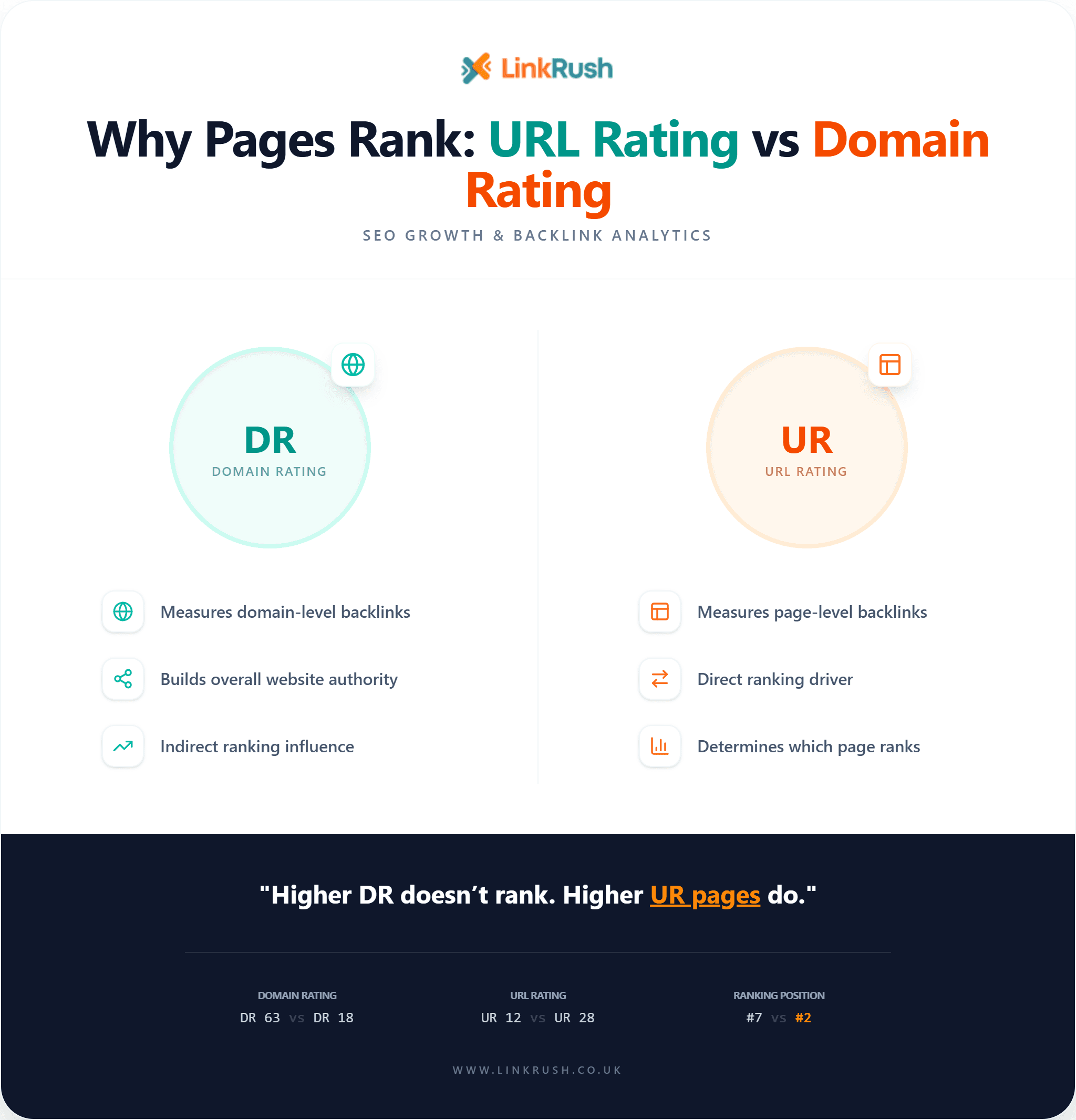
I’ve seen a DR 18 site outrank a DR 63 competitor for high-intent SaaS queries for months. The difference wasn’t domain power — it was page precision. Strong internal linking. Clean intent targeting. Higher UR on the ranking page.
When people compare url rating vs domain rating ahrefs, the practical answer is simple:
DR helps. UR competes. And no, that doesn’t mean DR is useless — it just means it’s often misapplied.
In one SaaS campaign last year, we worked on a DR 22 domain competing against two DR 60+ players. Instead of chasing links, we rebuilt internal linking and tightened intent alignment on three money pages. Within 8 weeks, two pages moved into Top 5. DR didn’t move at all during that period. That’s when it became obvious — page strength compounds faster than domain strength in mid-competition SERPs.
Domain Rating vs Domain Authority vs Authority Score
The debate around domain rating vs domain authority never really ends.
DR is from Ahrefs. Moz Domain Authority is calculated by Moz, while SEMrush Authority Score is another backlink-based metric developed by SEMrush to estimate overall domain strength and trust of a domain.
When someone asks about domain authority vs authority score, they’re comparing different proprietary estimation systems built on different link graphs.
None of them are Google metrics. They are directional signals based on proprietary link data, not part of Google’s ranking systems.
Confusing them with ranking factors creates strategic drift.
What Is a Good Domain Rating?
There’s no universal answer.
In local niches, DR 20 can dominate.In SEO or finance, DR 50 might struggle.
So when someone asks, “what is a good domain rating,” the real answer is: good relative to your SERP competitors.
Absolute numbers don’t matter. Relative strength does.
In a local services niche, we saw a DR 19 site outrank a DR 47 competitor for 11 high-intent keywords simply because the content mapped directly to transactional modifiers. The higher DR site had more links. The lower DR site had better intent precision. Rankings followed intent.
Why Do I Have No Domain Rating Ahrefs?
This is usually less dramatic than people assume.
If you’re wondering why you have no Domain Rating in Ahrefs, it usually comes down to fundamentals — no unique referring domains yet, links that are mostly nofollow, a very new domain, or sometimes AhrefsBot being blocked without realizing it.
Most of the time, it’s simply lack of linking data.
How to Increase Domain Rating Without Destroying Long-Term Performance
Search volume around increasing domain rating in Ahrefs is huge, which tells you how obsessed the industry has become with moving that number. Other Search intents
- how to increase domain rating
- how to increase domain rating in ahrefs
- how to increase ahrefs domain rating
The mechanism is simple: You need more unique referring domains.which often raises the question of how many backlinks a new website actually needs to start competing.
Not more blog posts. Not more internal links. Not better meta descriptions.
New linking domains increase DR.
We once pushed DR from 28 to 41 in under 90 days through aggressive outreach. The graph looked impressive. Rankings didn’t. Traffic stayed flat. Why? The links were clean — but irrelevant to the core revenue pages. DR rose. Commercial pages didn’t gain authority. That disconnect is where most teams misread ahrefs dr importance.
But there are two paths.
One builds authority through digital PR, citations, editorial placements, and strategies like guest posting vs niche edits.
The other inflates numbers — PBNs, sidebar links, expired redirects.
Both increase DR.Only one builds resilience.
That’s where domain rating vanity quietly wrecks strategies.
Selling Domain with High Ahrefs Rating — The Hidden Reality
There’s real demand around selling domain with high ahrefs rating.
High DR domains attract buyers.
But experienced buyers don’t buy the number. Here’s the part most sellers don’t like: some high-DR domains actually sell at a discount when buyers detect anchor manipulation or irrelevant geo links. A clean DR 32 with consistent topical anchors can be more valuable than a DR 58 built on random placements. They evaluate:
- Anchor text distribution
- Referring domain relevance
- Link velocity spikes
- Traffic stability
A DR 60 domain built on irrelevant anchors is unstable.
The score attracts attention. The profile determines value.
Transfer Domain to Cloudflare from GoDaddy — Does DR Change?
If you transfer domain to Cloudflare from GoDaddy correctly, nothing happens to DR.
Authority is not tied to your registrar.
What causes ranking drops during migration is:
- Broken redirects
- Lost canonical tags
- DNS errors
- Crawl disruption
Infrastructure mistakes hurt. Registrar changes don’t.
Domain Rating Vanity vs Real SEO Performance
If you model DR mathematically, it’s a function of referring domain strength. The domain is the input. The score (0–100) is the output range.
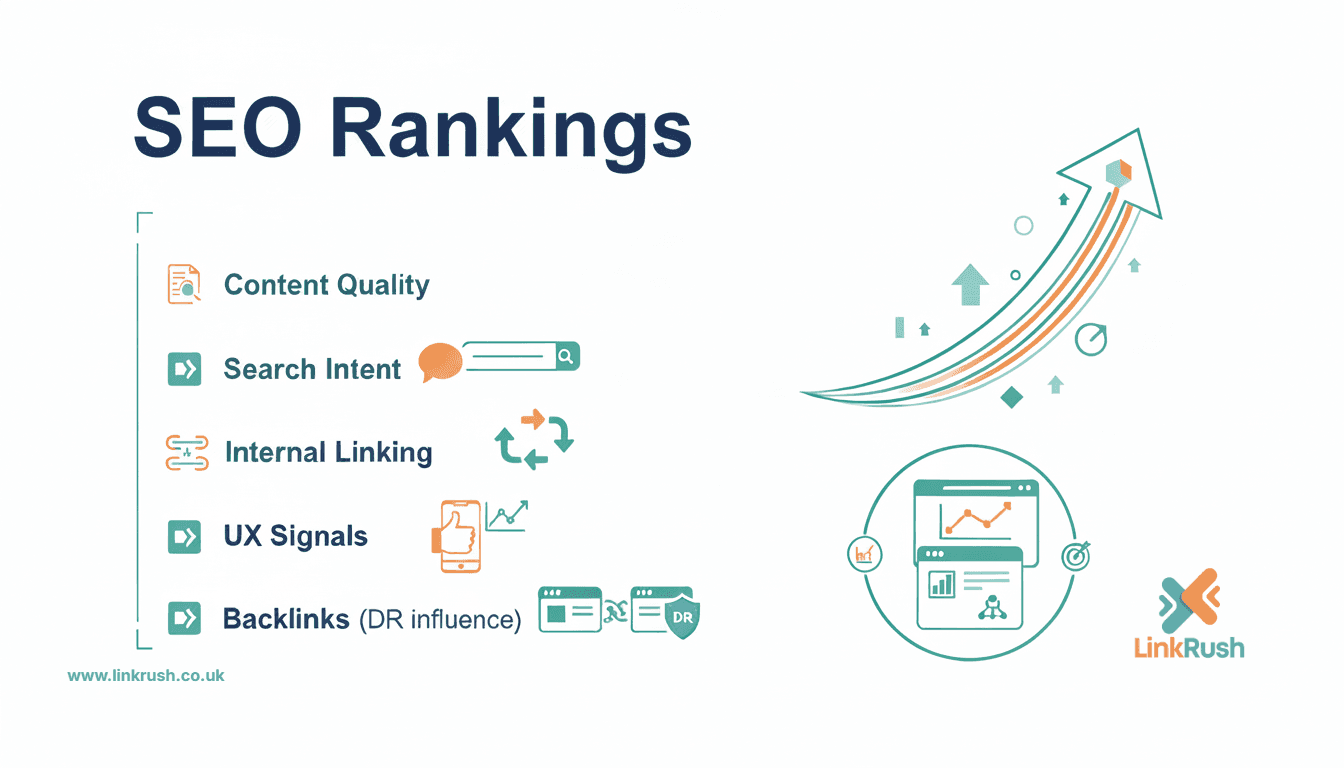
But ranking is a broader system — intent match, content depth, link equity distribution, UX signals, internal structure.
DR is one variable.
When teams treat it as the system, they optimize optics instead of outcomes.
And that’s why interpretation queries convert better than pure definition queries.
Someone searching “what is domain rating” is learning.
Someone searching “ahrefs dr importance” is evaluating strategy.
That difference matters commercially.
The Founder Take
If your roadmap says:
“Let’s move DR from 24 to 40.” You’re chasing a metric.
If your roadmap says:
“Let’s dominate this intent cluster.” DR becomes a side effect. Side effects last. Vanity metrics don’t.
Frequently Asked Questions About Ahrefs Domain Rating
Is Domain Rating a Google ranking factor?
No. Domain Rating is an SEO metric created by Ahrefs to estimate backlink strength. Google does not use DR as a ranking signal.
What is a good Domain Rating in Ahrefs?
A good Domain Rating depends on the competitiveness of your niche. In local industries, a DR 20–30 site can rank well, while in competitive niches like finance or SEO, higher DR levels are often needed.
Does increasing Domain Rating improve rankings?
Increasing DR can help indirectly by improving backlink strength, but rankings depend more on page-level authority, search intent alignment, and content quality.
The real takeaway is simple:
If you’re building for the next 12–24 months — not the next report screenshot — shift your focus. Stop optimizing for a score and start engineering authority around intent clusters that actually drive revenue through strategic link building services The rankings follow structure. The links follow values. The metric follows both.