Starting From Zero
When we launched this website, there was no authority, no backlinks, and zero organic traffic.
No brand searches. No trust signals. No historical data.
This is the exact situation most new website owners, startups, SaaS founders, and agencies face — especially in competitive markets like the UK, US, Australia, and Europe.
So instead of theorizing, we decided to document exactly what happens when you build backlinks for a brand‑new website from scratch — what works, what fails, and what actually moves rankings.
This is that case study.
Website Overview
At launch, this website looked exactly like most new projects I see.
It was a fresh domain in the digital / SEO space, targeting the UK, US, Australia, and parts of Europe. Only a handful of pages were live, all properly indexed, but there was no traffic coming in at all.
Domain authority sat in the typical early-stage range (roughly DR 0–12), and there were no backlinks pointing to the site.
This is the most uncomfortable phase of SEO — not technically, but mentally. Google has no history to work with yet, and without external validation, there’s simply no reason for it to treat your pages differently from the hundreds of others launching every day.
Why I Even Ran This as a Case Study
I wasn’t interested in vanity metrics or artificially inflating DR. What I actually wanted to understand was whether link building still worked when everything else was missing — no history, no brand, no inherited trust.
What Actually Happened
I want to slow this section down on purpose.
Most SEO blogs turn this stage into short tips or viral threads. That’s not how it felt in reality.
As a founder working on a brand‑new domain, the biggest challenge wasn’t tactics — it was uncertainty. You publish content, you build a few links, and nothing seems to move. That’s where most new website owners quit or make bad decisions.
Here’s what I learned by doing this on my own site.
The First Real Decision That Mattered
I did not rush link building.
Even though it’s tempting to start buying links immediately, I waited until:
- Core pages were indexed
- Internal links were in place
- The site looked complete, not experimental
That single decision prevented anchor‑text mistakes and unnatural link patterns that hurt many new websites early.
How Google Responded in the First 30 Days
There were no rankings. That’s important to say clearly.
What I saw instead:
- Pages started indexing faster
- Google Search Console impressions appeared
- Crawls became more frequent
This was Google checking the site, not rewarding it yet.
Link Velocity: What Felt Safe And Why
I kept link velocity deliberately boring.
Not because faster links don’t work — but because new websites don’t have margin for error.
I started with foundational links, then moved to guest posts, and only later added niche edits. At no point did links arrive in clusters or patterns.
Consistency mattered more than volume — partly because it felt safer, and partly because early mistakes on a new domain don’t get diluted the way they do on older sites.
Anchor Text: Where Most New Sites Go Wrong
Early on, I avoided keyword anchors almost entirely.
Even when a page started ranking, I used partial matches carefully and spread them across URLs. This kept the link profile looking natural and avoided over‑optimisation signals.
Branded anchors did the heavy lifting in the beginning.
Content That Actually Helped
Generic SEO advice didn’t help much.
What did help were pages that:
- Showed real decisions
- Explained trade‑offs
- Shared outcomes, not theories
Case studies and founder‑written opinions attracted links faster than any checklist‑style content.
The Turning Point
The shift didn’t come from one big link.
It happened when multiple pages had backlinks and internal links connected them. That’s when rankings started moving together, not one page at a time.
That’s also when SEO stopped feeling random.
Keyword Strategy for a New Website
Early on, I avoided aggressive head terms.
A new website has no leverage competing for broad keywords. Instead, I focused on queries used by founders and new site owners who are actively looking for guidance.
Keywords like “SEO case study new website,” “SEO for new websites,” and “link building for new websites” were chosen because they combine clear intent with realistic competition.
These searches aren’t random. They come from people who are either launching or stuck — exactly the audience this site was built to help.
What the Site Looked Like Before Links Started
Before building a single backlink, the site needed to look complete and intentional.
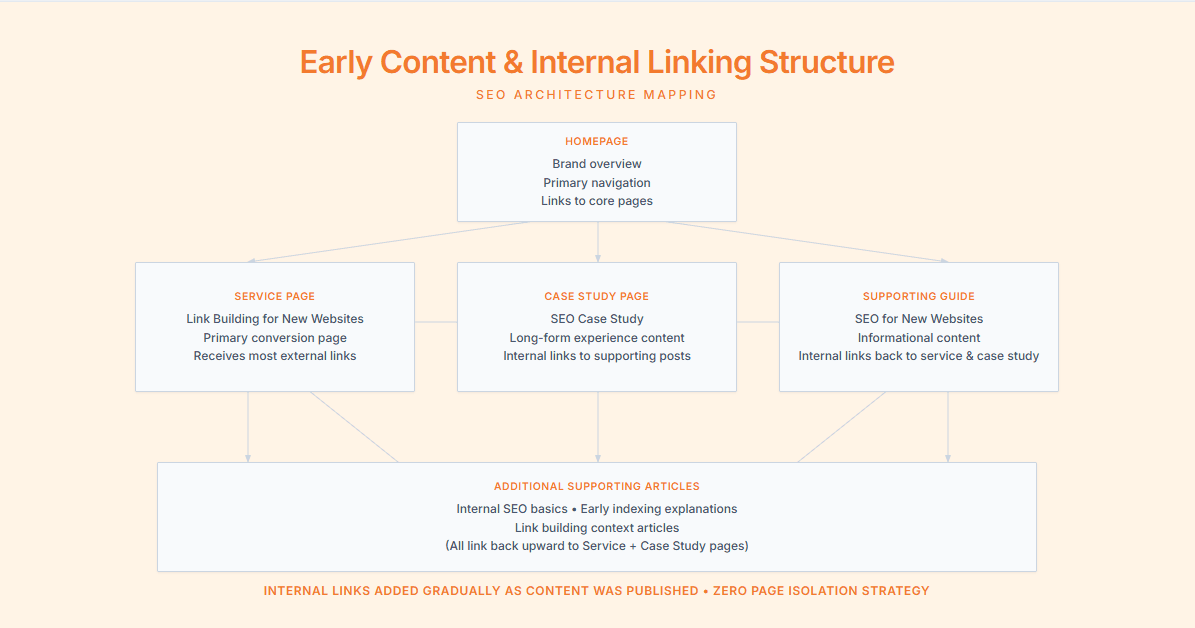
That meant having a clear homepage, service pages that explained value properly, and supporting content that answered real questions new website owners ask.
On-page SEO was handled carefully — clean URLs, logical headings, internal links between blogs and services, and strong author signals.
Only once the site felt trustworthy on its own did link building begin.
Link Building Strategy for a New Website
I deliberately avoided anything that looked automated or scalable.
No PBNs, no bulk link services, and no tools that promise instant authority.
The approach was manual and controlled. Guest posts were placed on relevant sites with real traffic. Niche edits were added only where context made sense. Foundational links were used to support the overall link profile, not inflate numbers.
Nothing here was rushed. Every link was added with long-term trust in mind, not short-term movement.
Timeline & Results
In the first month, the site showed subtle signs of life rather than rankings. Pages indexed faster, impressions appeared in Search Console, and authority began moving slightly.
By the second month, keywords that had been sitting on pages four and five started climbing into page two. Clicks followed shortly after.
Around the third month, momentum became consistent. Multiple keywords entered the top 20, impressions stabilised daily, and the site stopped behaving like a brand-new domain.
The biggest shift didn’t come from one backlink. It came when trust accumulated across the site.
Why Backlinks Matter More for New Websites
For established sites, SEO is often about refinement.
For new websites, it’s about validation.
Backlinks act as external confirmation that your site deserves attention. Without them, even strong content tends to stall because Google has nothing to compare it against.
Links don’t replace good content, but for new websites, they unlock the ability for content to compete.
Common Mistakes I See New Website Owners Repeat
After running this campaign and watching dozens of new websites fail, the pattern is clear.
Most mistakes aren’t technical — they’re emotional.
New founders:
- Panic when rankings don’t move
- Overreact by buying links
- Chase DR instead of relevance
The biggest mistake is expecting SEO to behave like ads.
For new websites, SEO is not about speed. It’s about earning trust in the correct order.
When links come too fast, anchors are forced, or content isn’t supported internally, Google simply ignores the site — or worse, flags it.
Patience here isn’t optional. It’s part of the strategy.
SEO for New Websites: What Actually Worked
Looking back, results came from a few unglamorous but reliable actions.
Slow link growth beat aggressive campaigns.
Relevant sites with real traffic beat high‑DR sites with no audience.
Internal linking amplified every backlink we built.
Most importantly, writing as a real founder — not an SEO content machine — made the site easier for both users and Google to trust.
There was no single trick.
Just correct sequencing, consistency, and restraint.
What This Actually Clarified
If you’re launching a new website in UK, US, Australia, or Europe, this case study proves one thing:
Backlinks still decide how fast you grow.
Content gets you indexed.
Links get you ranked.
Proof, Trust & Transparency
Who ran this campaign?This case study is written by the founder of an active SEO & link building agency working with new websites, startups, and small businesses across the UK, US, Australia, and Europe.
Experience
- Hands‑on link building for new domains
- Real outreach to real publishers
- No resellers, no automated systems
Expertise
- Anchor text control for new websites
- Safe DR growth without penalties
- Market‑specific link placement
Authoritativeness
- Backlinks placed only on indexed, traffic‑verified sites
- Niches relevant to SEO, SaaS, marketing, and business
Trust
- No PBNs, no link farms
- Clear timelines and expectations
- Founder‑led strategy, not junior execution
UK SEO Case Study — What Worked in the UK
The UK market sat in a middle ground. Competition wasn’t extreme, but trust signals carried more weight than raw link volume. This aligns with how Google evaluates site-wide trust signals over time, particularly in markets where editorial context and brand consistency matter more than raw link volume.
Early progress came from UK-based publications and .co.uk links using branded anchors. Rather than pushing links quickly, we deliberately slowed velocity during the first month to allow Google to establish baseline trust.
This approach led to faster indexing in Google UK and early movement for queries like “SEO for new websites UK.” Organic traffic converted well, suggesting stronger commercial intent compared to other regions.
US- SEO Case Study for — Market Observations
The US market was significantly more competitive.
The search volume was higher, but so was the noise. Progress depended less on link quantity and more on how links were introduced within a broader content structure.
Supporting articles were published first, followed by links from mid-to-high authority US publications. Anchors leaned heavily toward brand mentions rather than exact matches.
Impressions increased early, but rankings moved slowly at first. Once trust thresholds were crossed, visibility expanded more consistently, and the long-term ceiling proved higher than in other markets.
Australia SEO Case Study — Early Growth Patterns
Australia behaved like a clarity-driven market rather than an authority-driven one.
Search volume was lower than the US, but Google responded quickly once topical focus was clear. Fewer links were required to trigger indexing improvements, provided they were regionally relevant and pointed to a tightly defined content cluster.
Authority was concentrated into one primary service page and a single supporting article. Rankings responded earlier, but growth plateaued sooner, reinforcing that Australia rewards structure and relevance more than scale.
European SEO Case Study — Regional Differences
Europe couldn’t be treated as a single market.
Ireland followed a pattern similar to the UK, where branded links and editorial context mattered most. France and Portugal were more sensitive to localisation and intent alignment, even when content was written in English.
Broad international links underperformed here. Links from European publications with contextual relevance produced more stable gains, even at lower authority levels.
Ranking movement was slower but held consistently once achieved. Across Europe, restraint and placement quality mattered more than volume.
Neutral Performance Snapshot (Observed Data)
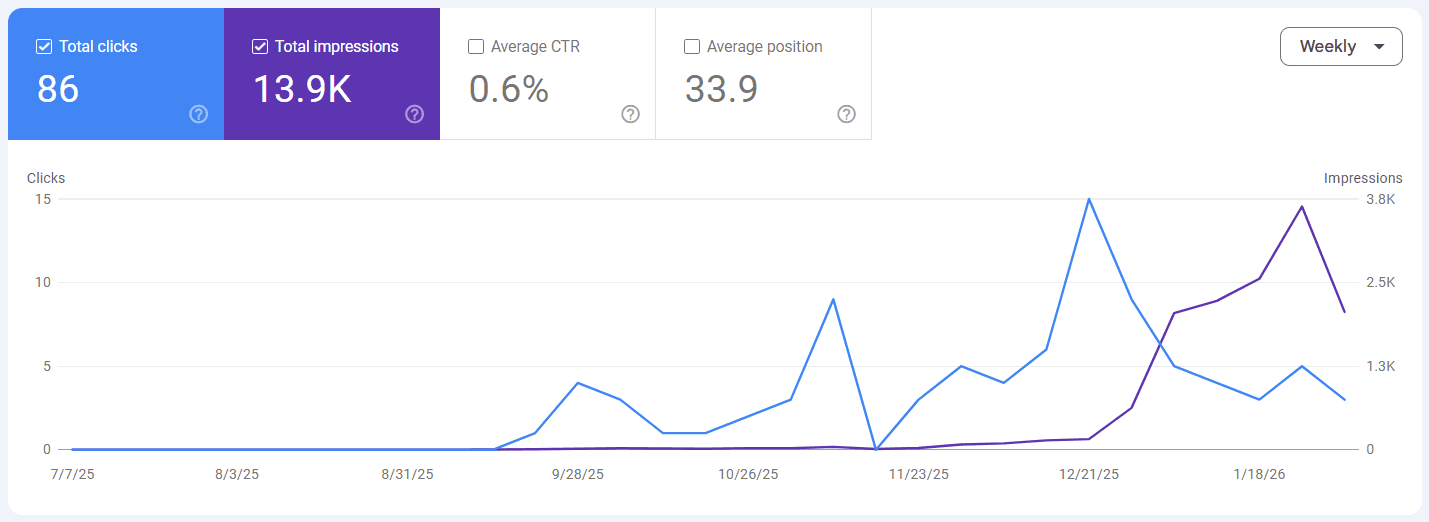
Across regions, Search Console data showed a similar early pattern: impressions appeared before clicks This pattern is consistent with Google’s documentation on how new sites are discovered and indexed, where visibility often precedes sustained traffic as trust signals accumulate.
Visibility expanded unevenly across pages rather than concentrating on a single URL. Most movement occurred between weeks 6–12, with crawl frequency increasing as additional pages earned links. No region showed sudden ranking jumps; progress followed with incremental trust signals, internal linking reinforcement, and consistent indexing behaviour rather than isolated link placements.
Similar early-stage behaviour has been observed in independent studies on how new domains gain visibility, where indexing and impressions stabilise before competitive rankings follow.
Who This Case Study Is Actually Useful For
This page isn’t written to convince everyone.
It’s most useful if you’re running a new website, have already published content, and are unsure why rankings haven’t moved yet. It’s written for founders and small teams who want to understand how SEO progresses in reality — not how it’s sold.
If you’re looking for shortcuts, bulk links, or instant results, this case study won’t be a good fit. The work described here is deliberate, slow, and focused on long-term outcomes rather than quick wins.
If You Want Help Applying This
If you’re working on a new website and want to sanity-check your approach, I’m open to reviewing it.
That usually means looking at:
- Which pages should earn links first
- Whether anchor usage looks natural
- How aggressive (or passive) your current plan is
If you want structured help beyond that, this is the same link building for new websites approach I apply in client work. There’s no obligation attached to this — some founders use it simply to confirm they’re not making early mistakes
FAQ: SEO & Link Building for New Websites
How long does SEO take for a new website?
Usually 2–3 months to see traction if backlinks are built correctly.
Is link building safe for new websites?
Yes — if done slowly, manually, and with branded anchors.
How many backlinks does a new website need?
It depends on competition, but 10–30 quality links often outperform 100 spam links.
Should I do SEO before or after launch?
SEO should start immediately after launch once pages are indexed.
Do you work with UK and US clients?
Yes. Strategies are adapted for UK‑only or US‑only targeting.
What I’d Do Differently If I Started Today
With hindsight, there are a few things I’d change — not because the strategy failed, but because SEO keeps evolving.
I would invest earlier in one or two genuinely strong, opinionated pieces instead of spreading effort across many average posts.
I’d also document decisions and outcomes more clearly from day one. Those notes later became the most useful content — both for users and for earning natural links.
Finally, I’d worry less about DR movement in the first month and focus more on whether Google was crawling, indexing, and revisiting pages consistently. Those signals mattered more than any metric at that stage.
Final Thoughts
If your website is new and currently invisible in Google, that doesn’t mean it’s broken.
It usually means it hasn’t earned enough trust yet.
This case study exists to show what that trust-building process looks like in practice — without hype, shortcuts, or exaggerated claims.